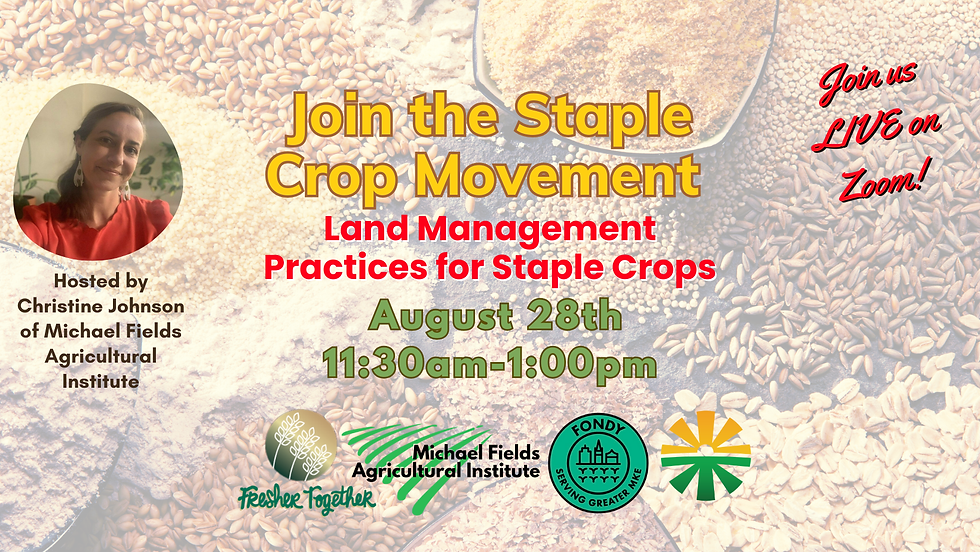
Staple Crops Lunch & Learn: Land Management Practices
Thu, Aug 28
|Zoom
Looking to diversify your farm or grow more of what your community eats? Join us for a community conversation about staple crops and how they can bring resiliency to our fields, food system and families.

Time & Location
Aug 28, 2025, 11:30 PM – Sep 17, 2025, 1:00 PM
Zoom
About the event
Looking to diversify your farm or grow more of what your community eats? Join us for a community conversation about staple crops and how they can bring resiliency to our fields, food system and families. Participants are encouraged to bring their questions and in the field experiences. What are Staple Crops? We describe staple crops to include foods that people eat regularly and that provide most of their energy and nutrients, like shelf-stable beans, grains, pulses, and more. This project will focus on staple crops traditionally grown in the Great Lakes region, plus any other culturally appropriate staple crops being grown for local communities and families.
Staple Crops include...
Grains: Such as wheat, oats, barley, rye, dry corn (including varieties for milling or feed), and rice.
Legumes and Pulses: Including dry beans (e.g., navy, pinto, black beans), lentils, chickpeas, and dry peas (such as split peas and cowpeas like black-eyed peas & pink eye purple hull peas).
Starchy Root and Tuber Crops: Like potatoes and sweet potatoes.
Oilseeds: Such as flax, soybeans and sunflower seeds, valued for their caloric density and versatility in oil and meal production.
Staple Crops are...
Calorically Dense: They offer substantial energy, making them efficient and vital food sources.
Nutrient-Rich: Beyond calories, they provide essential nutrients, contributing to a balanced and resilient food system.
Shelf-Stable/Storable: Their ability to be stored for extended periods without spoilage ensures year-round availability, supports consistent market access for farmers, and reduces food waste.
Foundational to Diets: They are widely consumed and often form a significant part of daily caloric intake across various populations.
Versatile: These crops can be used in numerous culinary applications and processed into a variety of food products, adding value for farmers and consumers alike.
Event Details
This webinar is part of a five-part series focused on the food crops that sustain us, connect us to our heritage and help us adapt to changing climates and food systems.
This event is FREE but registration is required.
Interested but don't think you can make it for the live session? Register anyways and we'll be sure to send you the recording!
Questions? Contact Christine Johnson, MFAI Farmer Education Coordinator at cjohnson@michaelfields.org or (262) 642-3303
This event is co-hosted by Michael Fields Agricultural Institute, Michigan Food and Farming Systems, Fondy Food Center, and Fresher Together.
About Michael Fields Agricultural Institute (MFAI)
MFAI is a non-profit organization that has been cultivating resiliency through research, education, and policy work since 1984. With a broad coalition of public and private partners, The Institute supports farmers, food systems and communities in the Upper Midwest and beyond through a range of programs and initiatives. We believe agriculture can sustain both human and ecosystem health, while advancing food security, independence, and justice. Follow along on Instagram and Facebook for news and events.
About Michigan Food and Farming Systems (MIFFS)
MIFFS is a statewide nonprofit with a mission to connect beginning and small-scale, diversified farmers, including farmers who underutilize support programs, to each other and resource opportunities to ensure resilient, healthy, vibrant, and viable local food systems.
About Fondy Food Center The Fondy Food Center cultivates wellness in the Lindsay Heights and Amani neighborhoods and the Greater Milwaukee Area by focusing on issues of healthy food access and economic opportunity. We operate local farmers markets throughout the year, provide access to land, resources and support to local farmers, and work with partners to build a better food system for our community.
About Fresher Together
Fresher Together is a Black and LGBTQ+ owned and led food and farming collaboration dedicated to
serving the people in our community with local nourishing foods and restorative spaces for healing, economic development, training and retreat.


