

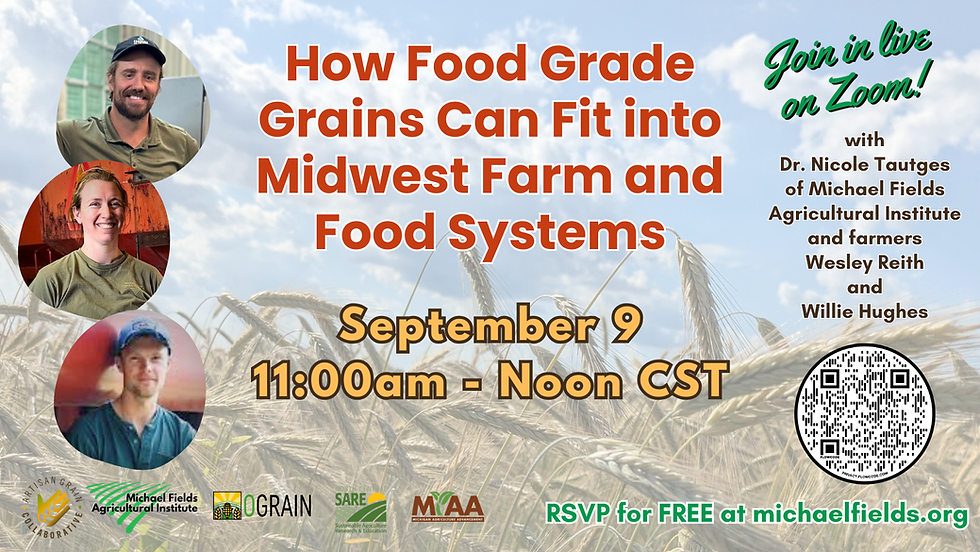
How Food Grade Grains Can Fit into Midwest Farm and Food Systems
Tue, Sep 09
|Webinar
Food-grade grains offer a win–win: a profitable value-added market opportunity and a boost to soil health when included in your crop rotation. But how do you ensure your grain meets the quality standards buyers expect?
Time & Location
Sep 09, 2025, 11:00 AM – 12:00 PM CDT
Webinar
About the event
Food-grade grains offer a win–win: a profitable value-added market opportunity and a boost to soil health when included in your crop rotation. But how do you ensure your grain meets the quality standards buyers expect?
In this webinar, we’ll tackle the most common questions about growing for the food-grade grain market.
Dr. Nicole Tautges, Lead Agronomist at the Michael Fields Agricultural Institute, will walk us through the varieties and market classes of common food grade grains in the Upper Midwest, along with and key agronomic tips for growing success.
We’ll also hear firsthand from two seasoned farmers, Wesley Reith and Willie Hughes, who have years of experience growing a wide range of food-grade crops. They’ll share what’s worked, what hasn’t, and the lessons they’ve learned along the way.
Questions? Contact Nicole Tautges at 509-432-6489; ntautges@michaelfields.org
This webinar is FREE to attend but registration is required.
Interested but don't think you can make it for the live session? Register anyways and we'll be sure to send you the recording!
This event is hosted by The Michael Fields Agricultural Institute (MFAI), with support from Artisan Grain Collaborative (AGC), University of Madison Wisconsin Organic Grain Resource and Information Network (OGRAIN), North Central Region SARE, and Michigan Agriculture Advancement (MiAA).
About Michael Fields Agricultural Institute (MFAI)
MFAI is a non-profit organization that has been cultivating resiliency through research, education, and policy work since 1984. With a broad coalition of public and private partners, The Institute supports farmers, food systems and communities in the Upper Midwest and beyond through a range of programs and initiatives. We believe agriculture can sustain both human and ecosystem health, while advancing food security, independence, and justice. Follow along on Instagram and Facebook for news and events.
About Artisan Grain Collaborative (AGC)
AGC is a network of farmers, millers, maltsters, bakers, chefs, food manufacturers, brewers, distillers, researchers, and advocates working together to strengthen a regenerative grainshed in the Midwest. We facilitate a network to create and strengthen relationships along the grain supply chain throughout our region. We connect farmers, processors, makers, and advocates, develop resources, and build awareness of regional grains.
About University of Wisconsin–Madison Organic Grain Resource and Information Network (OGRAIN)
OGRAIN is a collaborative program of UW–Madison dedicated to supporting organic grain farmers in the Upper Midwest. Bringing together researchers, educators, and experienced farmers, OGRAIN offers training, field days, conferences, and resources to help growers succeed in organic production. By advancing knowledge and building community, OGRAIN works to strengthen organic grain systems that benefit farmers, consumers, and the environment.
North Central Region SARE
North Central SARE strengthens communities, increases producers' economic viability, and improves the environment through grants and education.
About Michigan Agriculture Advancement (MiAA)
MiAA empowers alternatives to the commodity agriculture system that has prioritized production efficiencies at the expense of farm resiliency, production flexibility, food value, and environmental impacts. MiAA supports the work of innovative farmers building soil health and diversifying crop rotations. Recognizing the value of these changes extends beyond the farm through limited environmental impacts and enhanced local food economies, MiAA works for policies and investments to achieve a stronger agriculture system in Michigan.
This material is based upon work that is supported by the National Institute of Food and Agriculture, U.S. Department of Agriculture, under agreement number 2023-38640-39573 through the North Central Region SARE program under project number ENC23-22. USDA is an equal opportunity employer and service provider. Any opinions, findings, conclusions, or recommendations expressed in this publication are those of the author(s) and should not be construed to represent any official USDA or U.S. Government determination or policy.
